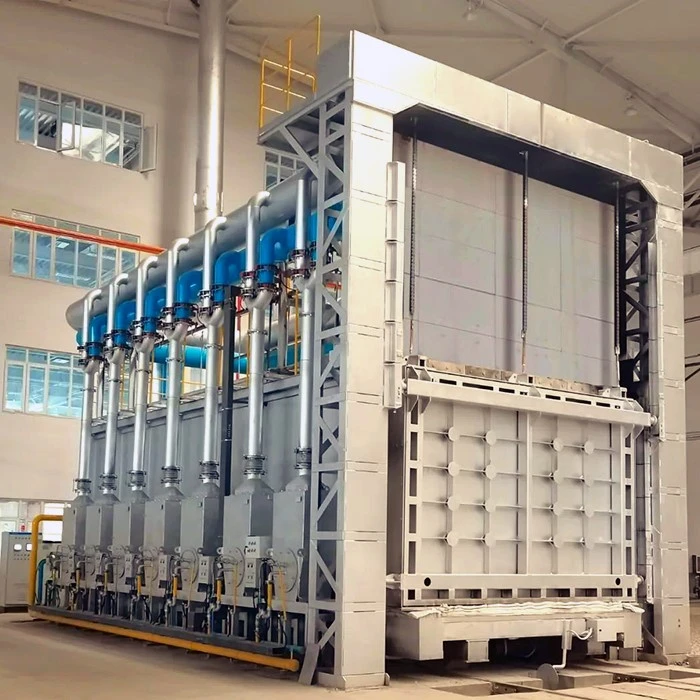
(1) Heat treatment furnaces have a wide temperature range. The main purpose is to obtain austenitic steel with good plasticity, with a temperature range of 900–1200℃. Depending on the process requirements, the temperature can reach as high as 1300℃ or as low as around 100℃. This large temperature difference necessitates significant differences in furnace structure. Furnaces with temperatures above 650℃ are called high-temperature heat treatment furnaces, where heat transfer is primarily through radiation, supplemented by convection; furnaces with temperatures below 650℃ are called low-temperature heat treatment furnaces, where heat transfer mainly relies on convection. Heat treatment requires uniform furnace temperature to avoid localized overheating, so the furnace chamber and combustion chamber are sometimes separated.
(2) Heat treatment furnaces have strict temperature control. Pre-pressure processing heating with metal temperature fluctuations of 10–20 degrees Celsius generally has little impact on quality. However, whether the heat treatment furnace can guarantee the required temperature for the heat treatment process has a significant impact on product quality, generally with fluctuations not exceeding 3–10℃. The temperature distribution on the cross-section of the heated material should be as uniform as possible, with a temperature difference not exceeding 5–15℃. In terms of furnace temperature control, electric furnaces are superior. To achieve accurate temperature control, it is best to uniformly arrange low-power flameless or flat-flame burners, which facilitates segmented control. Too few burners, or excessive concentration, can easily lead to localized overheating. Simultaneously, the arrangement of burners or heating elements and the furnace structure should facilitate furnace gas circulation, making the furnace temperature more uniform. For this purpose, fans can be used inside the furnace
(3) Heat treatment furnaces should minimize metal oxidation and decarburization. For steel heat treatment, surface oxidation and decarburization are not allowed; the surface should be kept smooth. Heat treatment furnaces often require sealing to control the furnace gas composition and sometimes maintain a specific atmosphere within the furnace chamber. For example, bright annealing of cold-worked steel is mostly carried out in a protective gas medium or in a vacuum, so muffle furnaces and radiant tubes are widely used in heat treatment furnaces. When workpieces or steel undergo chemical heat treatment, such as carburizing, nitriding, and cyaniding, they must be heated in an active medium with a certain composition, requiring a muffle furnace or bath furnace. (4) The productivity and thermal efficiency of heat treatment furnaces are low. During heat treatment, in order to make the temperature uniform on the metal cross-section and to make the crystal structure complete, the metal needs to stay in the furnace for a long time. Regardless of the type of heat treatment, the material has one or more homogenization or holding stages in the furnace, and the cooling process often takes place in the furnace. Some types of heat treatment even require multiple heating, holding and cooling processes. Many heat treatment furnaces operate cyclically. For the above reasons, the productivity and thermal efficiency of heat treatment furnaces are much lower than those of furnaces used for rolling and forging heating.