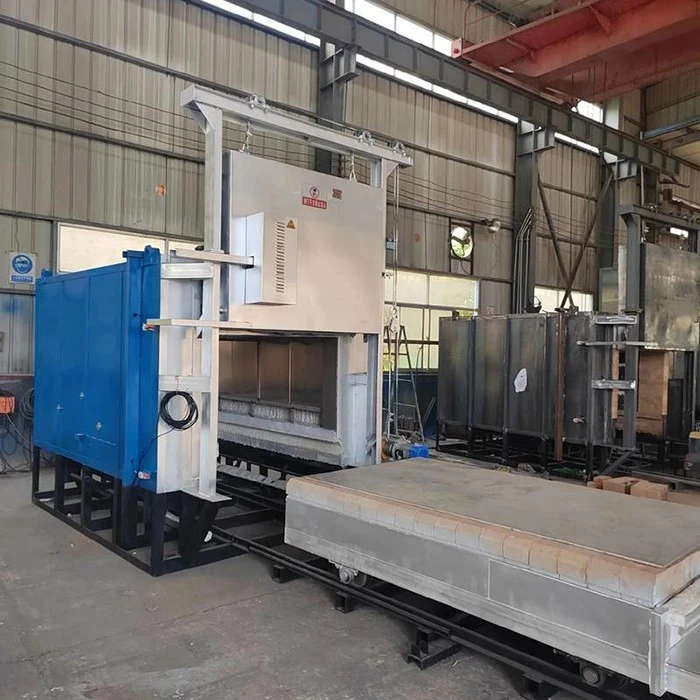
Heat treatment furnaces are electric or fuel-fired furnaces used for heating furnace charge during heat treatment. They are mainly used in metal heat treatment processes such as annealing, quenching, and carburizing, and include types such as box-type resistance furnaces, pit-type resistance furnaces, gas carburizing furnaces, and salt bath furnaces. According to the heating medium, they can be divided into three categories: gas (air, controlled atmosphere), liquid (molten salt, molten lead), and solid (flowing particle furnace). According to the operation mode, they are divided into continuous furnaces and periodic furnaces. Among them, salt bath furnaces use molten salt as the medium and have the characteristics of fast heating speed and stable quality, but they have the problems of complex operation and high labor intensity.
Continuous furnaces use heat-resistant steel guide rails, walking beams, or push rods to move workpieces. In recent years, heat-resistant steel conveyor belts have been gradually adopted to achieve continuous loading and unloading, improving the level of automation. This equipment needs to meet the furnace temperature control accuracy of ±3-10℃ and uses radiant tubes or muffle covers to prevent oxidation and decarburization. However, because the workpieces need to be heated and held at different temperatures multiple times, the thermal efficiency is relatively low. Modern technological development focuses on optimizing the combustion control mathematical model and dynamically adjusting the steel plate running speed, promoting the intelligent upgrading of heat treatment production.