

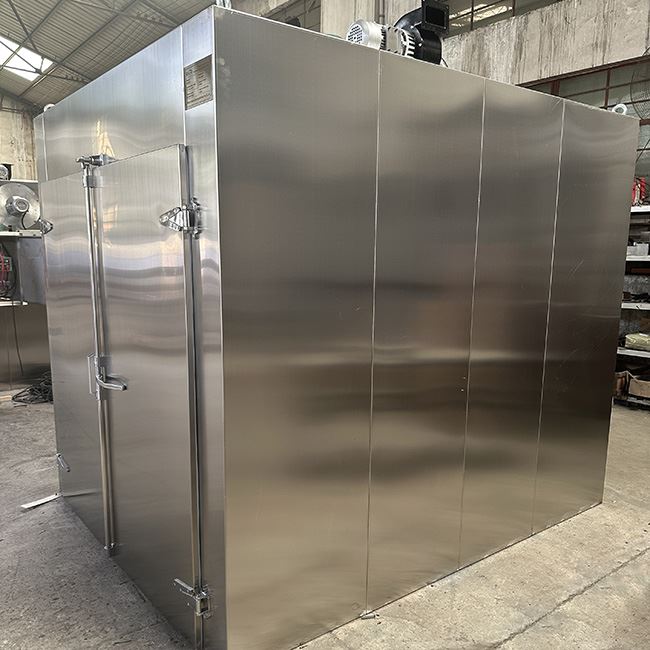
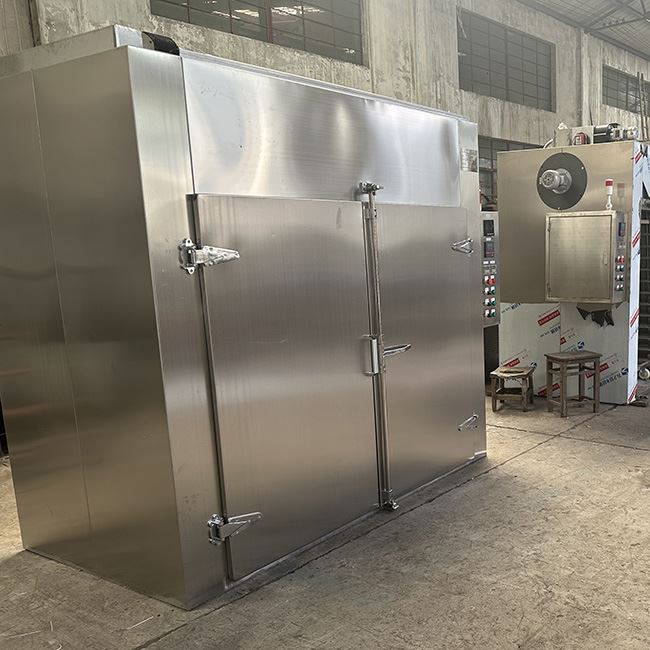
Product Introduction
The industrial drying oven removes moisture or surface liquids from materials under controlled heating conditions. It is commonly used for batch drying, component preheating, moisture reduction, and thermal conditioning before the next production stage.
Depending on the process requirements, available configurations may include electric heating, natural or forced-air circulation, adjustable exhaust, and programmable temperature control. Chamber structure, loading method, airflow arrangement, and control system are selected according to the material, batch size, and workshop layout.
Small components may be loaded on trays or shelves, while larger workpieces may require racks or trolleys. Materials with high moisture content usually need a different ventilation arrangement from products that only require surface drying.


Working Principle
The industrial drying oven provides controlled heating to remove moisture from materials. Depending on the design, heat is transferred through forced hot-air circulation, natural convection, or another specified heating arrangement.
In a forced-air model, the heating elements warm the air, and a circulation fan moves it through the chamber. Heated air transfers energy to the material, allowing moisture to evaporate. Where ventilation is required, the exhaust system removes moisture-laden air, and the fresh-air supply can be adjusted according to the drying process. The appropriate balance between air circulation and exhaust depends on the material, moisture load, and required drying conditions.
Drying time depends on material composition, initial moisture content, loading density, target temperature, and the required final condition. A densely packed load may dry differently from a lightly loaded chamber, even when both use the same temperature setting.
For procurement, the main considerations are whether the oven can accommodate the actual load, maintain the required process temperature, provide suitable airflow, and remove moisture at an appropriate rate.
Features
Flexible batch processing: suitable for drying materials in defined batches, with loading arrangements adapted to different workpieces.
Configurable heating system: heating capacity and control settings can be selected according to the required process temperature and batch load.
Airflow options: natural convection or forced hot-air circulation can be considered according to material sensitivity and drying requirements.
Adjustable ventilation: air inlet and exhaust arrangements can support moisture removal where the process requires air exchange.
Custom chamber design: chamber dimensions, shelves, racks, doors, and loading methods can be adapted to the production layout.
Process-oriented controls: temperature settings, timers, and optional control functions can be selected to match the operating procedure.
Actual temperature uniformity, heating rate, drying time, and energy consumption depend on the final design, material properties, loading conditions, and operating settings. These values should be established through technical evaluation or testing rather than assumed from the equipment category alone.
Application
Metal Parts and Components
Industrial drying ovens can dry metal components after washing, degreasing, or water-based cleaning. The required temperature and cycle time depend on the part geometry, residual moisture, surface treatment, and downstream process.
Electrical and Electronic Components
Selected electrical components, insulating parts, and electronic assemblies may require moisture removal or preheating before assembly or further processing. Temperature limits should be confirmed for sensitive materials and assembled components.
Coatings, Paints, and Adhesives
An industrial drying oven can be used for drying or curing compatible coatings, paints, and adhesive systems. The required time-temperature profile depends on the product formulation and the manufacturer's process specifications.
Plastic and Polymer Materials
Certain plastic resins and molded polymer parts may require drying or thermal conditioning before further processing. The operating temperature, airflow, and drying duration should be selected according to the specific material and process requirements to avoid deformation or thermal degradation.
Chemical and General Industrial Materials
Selected powders, granules, and solid industrial materials may require moisture reduction before packaging, storage, or further processing. Material stability, dust generation, solvent content, and ventilation requirements should be reviewed before equipment selection.
Preheating and Intermediate Production Processes
Industrial drying ovens can also provide controlled preheating for components before assembly, coating, bonding, or another specified manufacturing operation. The temperature range and holding time should be determined by the process requirements.
Product Structure
The working chamber is made of high-quality steel plate or stainless steel plate.
Microcomputer intelligent temperature controller, featuring dual digital display for set temperature and measured temperature, timing function, power suppression and auto-tuning function, delivering accurate and reliable temperature control.
The hot air circulation system consists of low-noise fans and air ducts, ensuring uniform temperature inside the working chamber.
Hot Tags: industrial drying oven, China industrial drying oven manufacturers, suppliers, factory, Double Cone Rotary Vacuum Dryer, Electric Drying Oven, Electric Motor Drying Oven, Industrial Curing Oven, industrial oven, Tunnel Drying Oven


